
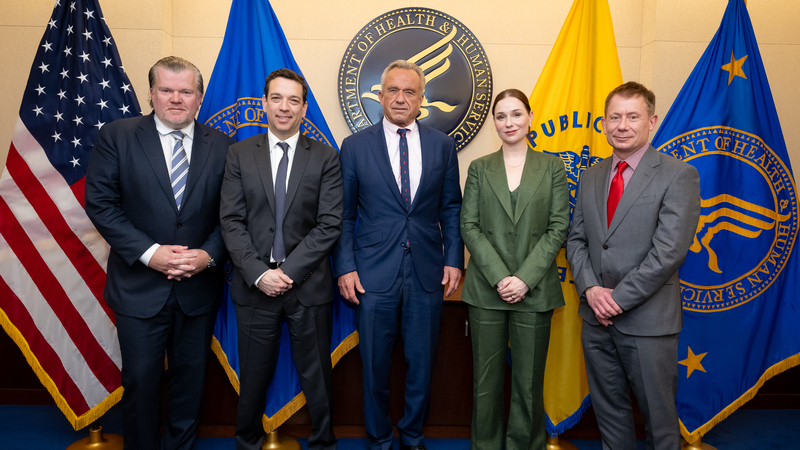
Health and Human Services Secretary Robert F. Kennedy Jr. has spent the first year of President Donald Trump's second administration trying to implement his Make America Healthy Again (MAHA) vision. But his mission hit a roadblock during the holiday season when an Obama-appointed judge issued a ruling siding with a conglomerate of dye companies to stifle a landmark ban on artificial food additives.
During his first trip as America’s lead healthcare official in March, Kennedy spoke in Martinsburg, W.V., alongside Gov. Patrick Morrisey, who said his state’s ban plan and the Democrat scion’s choice to visit the area first shows the "MAHA" movement "begins right here in West Virginia."
By Wednesday, a federal judge in the Mountain State, Judge Irene Berger of the Southern District of West Virginia, blocked those plans, siding with food dye manufacturers and issuing a preliminary injunction halting Charleston’s ability to enforce the policy Morrisey championed at Kennedy’s event.
Berger issued a 30-page ruling blocking enforcement of HB 2354, a law drafted by Del. Adam Burkhammer, R-Upshur, which bans food and pharmaceuticals that have been "adulterated" with artificial compounds including butylated hydroxyanisole, Red 3, Red 40, Yellow 5, Yellow 6, Blue 1, Blue 2 and Green 3.
Knowingly contaminating food with such artificial dyes and compounds would have resulted in a potential misdemeanor charge and $500 fine, according to the Wheeling News-Register.
Red 3 is already banned by the FDA, in part due to lab tests on rats that found development of thyroid issues and cancerous side effects, according to NIH and HHS documents.
The case was brought by the International Association of Color Manufacturers, a K Street organization that alleged the bill causes economic harm to its member companies, that it lets Charleston "usurp" Washington’s power to regulate food safety and also interferes with interstate commerce, a federal concern.
While Berger ruled in IACM’s favor, she also rejected their claim that the policy was an unlawful bill-of-attainder, or law singling out a person or group, according to the News-Register.
In a statement, Morrisey said he "respectfully disagree[s] with [the] ruling."
"[W]e believe this decision is premature and incorrectly decided. West Virginia will continue to defend its authority to protect the health and well-being of our citizens, especially children," he said.
"We are reviewing our legal options and will continue to press forward with our efforts to get harmful crap out of our food supply."
- Article Source:
Fox News

- Photo:

